2022-09-05, 2022-10-06 / Image Details (Click on image to enlarge)
galacticsights
astrophotography
Technical Details
| Location | Zollikerberg, Switzerland |
| Camera | Nikon DSLR D810A |
| Telescope | TS ONTC 12" f/4 Carbon Newton |
| Optics | TS 2,5" Wynne Coma Corrector |
| Focal Length | 1140mm |
| Mount | iOptron CEM120 Center-Balanced Equatorial Mount |
| Autoguiding | MGEN-3 (Dithering) |
| Focuser | Moonlite |
| Planetarium Software | Stellarium | Image Session Control | APT - Astro Photography Tool v4.01, ASCOM Platform 6 |
| Lights | 92/61 x 120s (total 5h06'), ISO-1600, additional Biases, Flats, no Darks |
| Stacking Software | Pixinsight 1.8, Drizzle 2x |
| Image Processing | Pixinsight 1.8 |


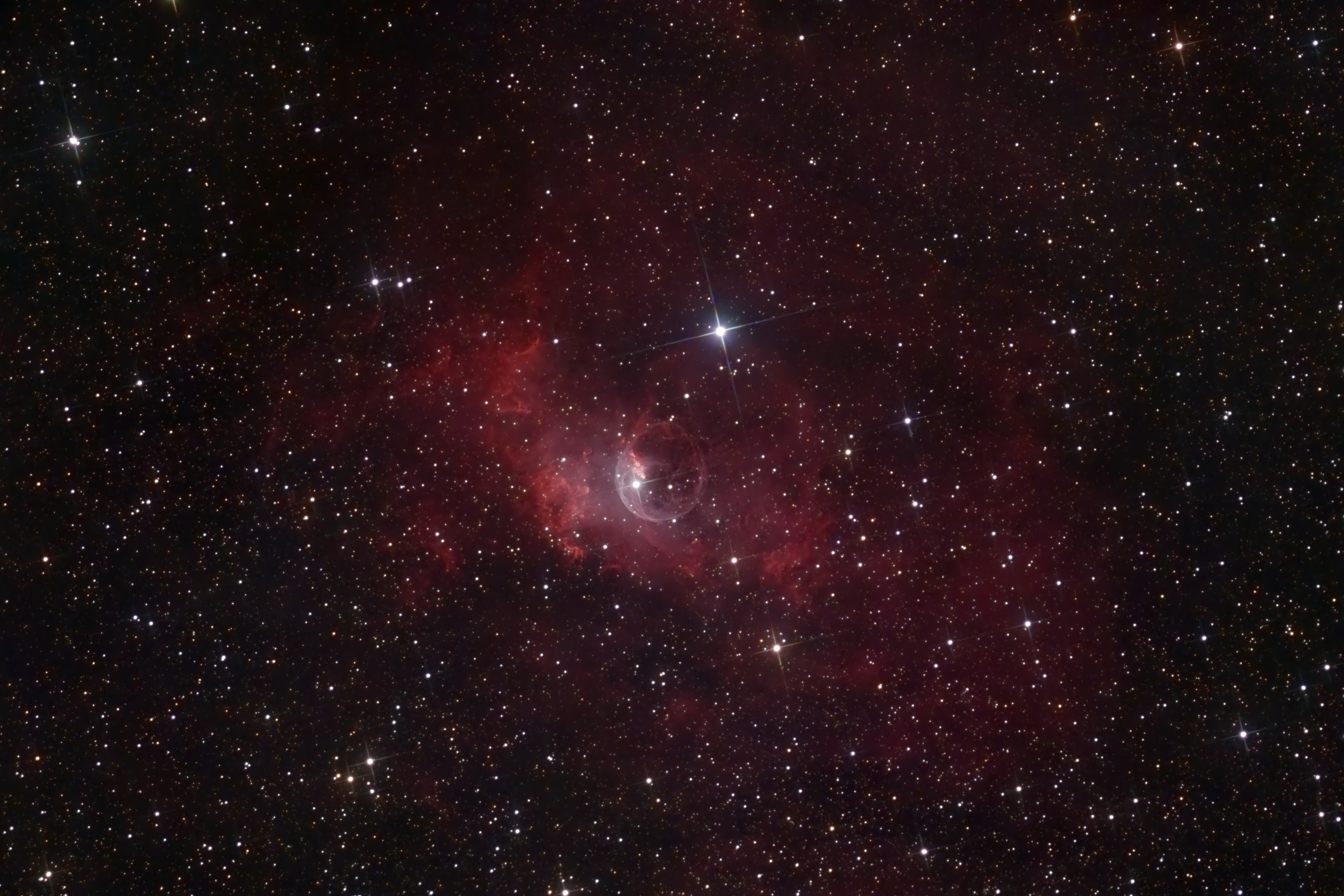
NGC 7635, also called the Bubble Nebula, is an H II region emission nebula in the constellation Cassiopeia. It lies close by the open cluster Messier 52. It was nicknamed the Bubble Nebula because of its shape, which was created by a strong stellar wind from a young, massive, hot star that shed its material to form the nebula.
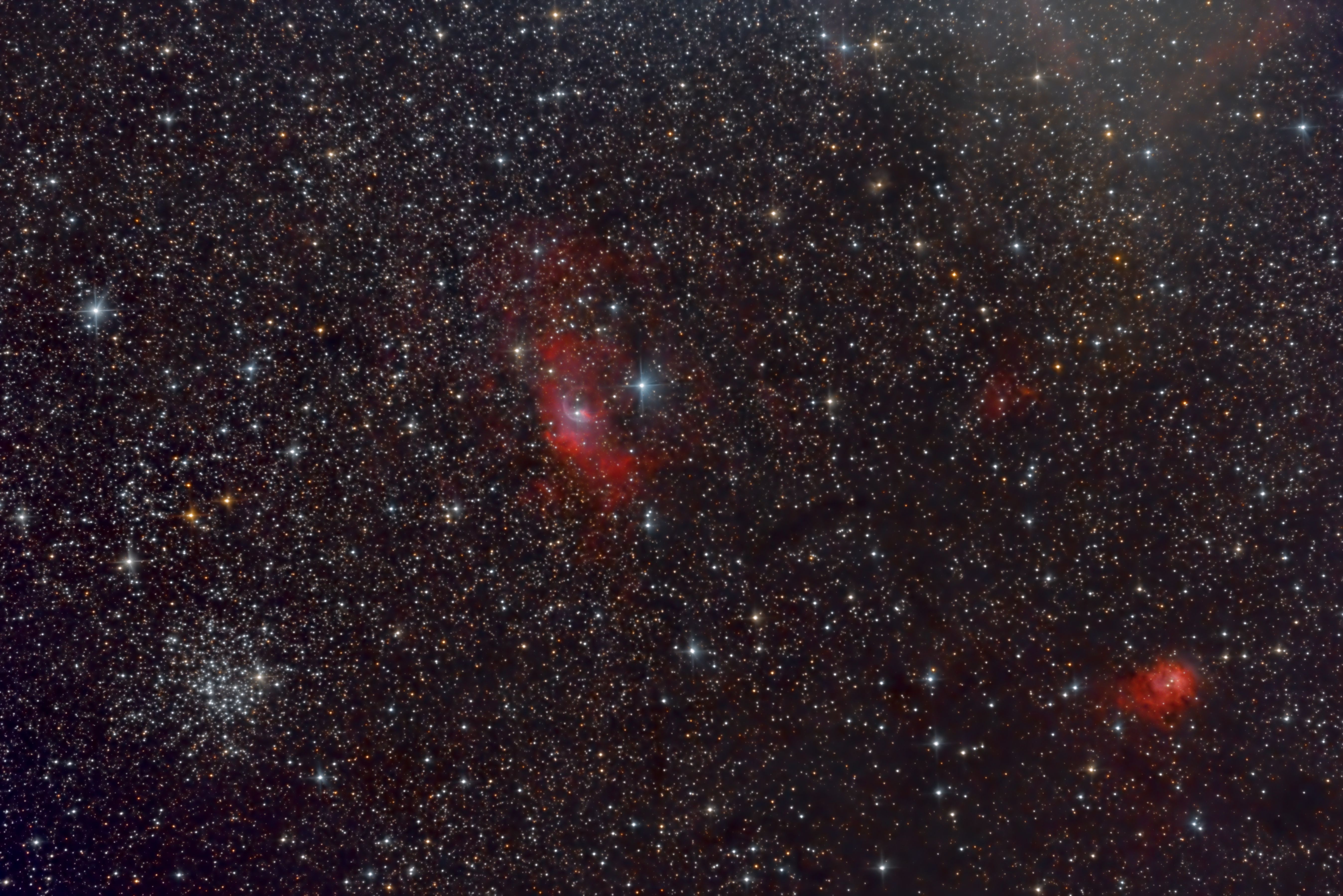
M52 is one of Charles Messier's original discoveries, who cataloged it on September 7, 1774. He noticed it after a comet he was observing passed close by.
Technical Details
| Location | Zollikerberg, Switzerland |
| Camera | Nikon DSLR D810A |
| Telescope | Skywatcher Quattro 8CF 200 DS Fibre OTA Newton Carbon |
| Special Lense | Skywatcher Newtonian F4 Coma Corrector |
| Mount | Skywatcher AZ-EQ6, EQASCOM, Stellarium |
| Autoguiding | Lacerta MGEN2 (Autoguiding, Dithering und Camera Control) |
| Camera Control | Digicamcontrol (Focus, Camera Control) |
| Lights | 52 x 120s (1h44'), ISO-1250, additional Biases, Flats, no Darks |
| Stacking Software | Pixinsight 1.8 |
| Image Processing | Pixinsight 1.8 |
NGC 7635, also called the Bubble Nebula, is an H II region emission nebula in the constellation Cassiopeia. It lies close by the open cluster Messier 52. It was nicknamed the Bubble Nebula because of its shape, which was created by a strong stellar wind from a young, massive, hot star that shed its material to form the nebula.